
Franchise Buyer Persona Profile: The Industry Insider
This article is part of an ongoing series that examines the 15 franchise buyer personas shaping today's franchise landscape. Each persona represents a distinct segment of candidates, defined by their backgrounds, motivations, and decision-making behaviors, that franchise brands must understand to successfully attract, engage, and support the right owners for their system.

In this installment, we take a deep dive into the Industry Insider. This is a buyer who approaches franchise ownership not as a leap of faith but as a calculated next step. They come with deep sector knowledge, operational fluency, and a clear-eyed view of what it takes to make a unit perform. They are not exploring entrepreneurship. They are deploying expertise.
Here, we will explore the defining characteristics, motivations, pain points, and franchise preferences of the Industry Insider. We will examine how these buyers evaluate investment opportunities, what financial evidence they require before committing, and why operational credibility and data transparency are central to converting this persona.
Finally, we will cover actionable marketing strategies and messaging insights for connecting with and converting this high-value buyer. From the importance of data-driven content and peer validation to the role of structured discovery and leadership access, each section provides practical guidance for engaging the Industry Insider on their path to franchise ownership.
Who Is the Industry Insider?
The Industry Insider is one of the most analytically sophisticated franchise buyer personas in the market. These individuals typically have direct experience working inside franchise systems, managing operations at scale, or leading teams within the very industry a franchise serves.
Unlike buyers who are discovering business ownership for the first time, the Industry Insider already understands the mechanics of franchising. They know how royalties work, what a good FDD looks like, and how to read unit-level performance data. What they are evaluating is not whether franchising makes sense. They are evaluating whether your specific franchise makes sense for their capital, skills, and long-term goals.
What Is the Demographic Profile of the Industry Insider?
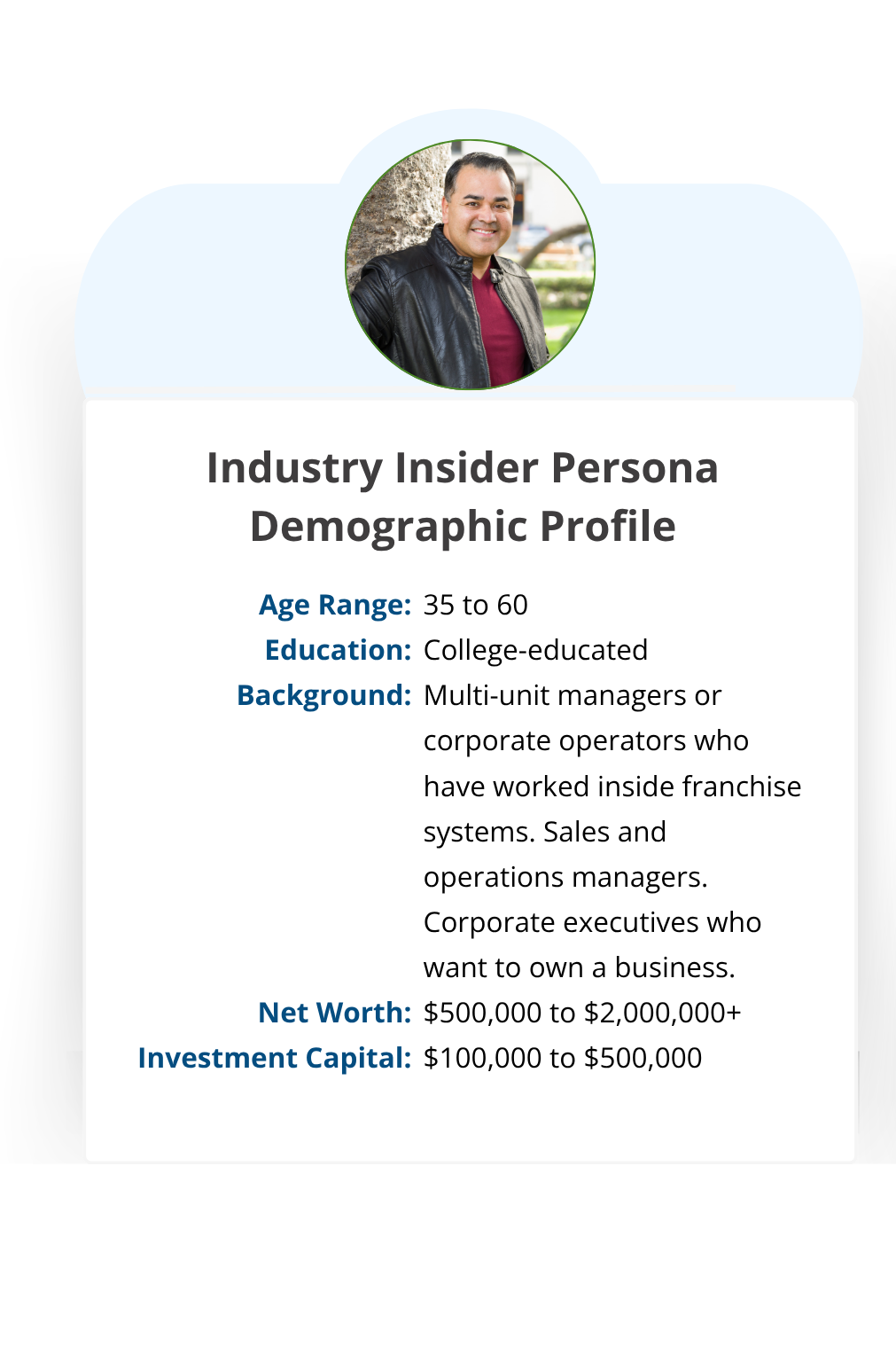
The Industry Insider is a mature, experienced professional with a strong financial foundation and a track record that spans multiple years of operational or industry leadership.
Most Industry Insiders fall between the ages of 35 and 60. They share common career profiles, including:
Multi-unit managers or corporate operators who have worked inside franchise systems
Regional or national sales and operations leaders within the same or adjacent industry
Corporate executives who are financially fluent but eager to own rather than manage for someone else
This group is not early-career. They have built equity, managed teams, and operated within complex organizations. They are now looking for a smarter way to apply what they already know.
Industry Insiders are college-educated. Common fields of study include:
Business administration and management
Operations, supply chain, or finance
Industry-specific disciplines such as hospitality, healthcare, or engineering
Many also hold advanced degrees or professional certifications that reflect specialized expertise in their sector.
This persona has established financial roots. Individuals who fit this profile typically have a net worth in the range of $500,000 to $2 million or more, drawing from savings, retirement accounts, home equity, and other assets. They come to the table with liquid capital commonly in the $100,000 to $500,000 range, accessible through cash, securities, or a home equity line of credit.
Industry insiders have strong credit profiles and existing relationships with banks, SBA lenders, or private financing sources. Personally, they have established households with mortgage obligations and, in many cases, family financial commitments.
They are comfortable with leverage but cautious about over-concentration. They evaluate financing as one component of total risk, not as a way to stretch beyond what the numbers support.
Psychographically, Industry Insiders are:
Analytical and data-driven in their evaluation approach
Skeptical of marketing claims that are not backed by verifiable numbers
Oriented toward long-term asset creation, not just income replacement
Acutely aware of their own time value and the opportunity cost of any decision they make
What Motivates the Industry Insider to Buy a Franchise?
For the Industry Insider, franchise ownership is a strategic move, not an emotional one. They are not running away from something. They are moving toward a specific outcome that their current role cannot offer.
Ownership Without Starting From Zero. The most consistent motivator for this persona is the desire to own something without taking the full risk of building from scratch. They understand the value of a proven system and want to leverage it. Franchising offers them a structure they can work within while still owning the outcome.
Deploying Expertise for Personal Gain. Many Industry Insiders have spent years building value for someone else's brand. Their core motivation is to redirect that expertise toward something they own. They bring:
Deep understanding of operations, cost management, and customer experience
Industry relationships and networks that create competitive advantages
Management skills that translate directly to running a franchise unit or portfolio
Financial Advancement Beyond a Salary. Industry Insiders understand the ceiling that comes with a corporate salary. Key financial motivators include:
Higher income potential with a direct connection between effort and outcome
Long-term asset creation through equity in one or multiple franchise locations
Potential for multi-unit or area development that compounds returns over time
Clarity around exit value and what the business is worth at the point of sale
Reduced Risk Relative to Independent Business Ownership. This persona values the risk mitigation that franchising offers compared to a standalone startup. Proven systems, established brand recognition, training infrastructure, and ongoing support all reduce the variables they must manage. They are not afraid of risk. They want risk that is quantifiable and manageable.
What Kind of Franchises Draw Industry Insiders?
Industry Insiders are highly selective. They look for franchise models where their prior experience gives them a direct operational or competitive edge, and where the unit economics are clear, consistent, and repeatable.
They prioritize franchises with:
Sectors they already know: Foodservice, retail, home services, B2B services, fitness, or healthcare, depending on their professional background
Operationally mature systems: Established playbooks, documented standard operating procedures, and a strong field support infrastructure
Scalable, multi-unit capable models: Clear pathways to add locations, develop territories, or expand into adjacent verticals over time
Strong brand and technology backbone: Systems that drive revenue, track KPIs, and support operational efficiency at the unit level
This persona is less attracted to:
Early-stage concepts with unproven models or limited FDD history
Trend-driven brands that lack defensible long-term economics
Models that depend primarily on the franchisee's personal charisma or sales ability rather than on repeatable systems
The Industry Insider is also attuned to the quality of available territories. They evaluate whether the brand's prime growth window has already passed or whether a meaningful market opportunity still exists.
How Quickly Do Industry Insiders Commit?
Industry Insiders move deliberately. They are not impulsive buyers, but they also do not stall indefinitely when the evidence is compelling. Their decision process tends to unfold in three phases.
The timeline from active evaluation to signed agreement typically runs 30 to 90 days for those with strong conviction and available capital. It can extend beyond that for buyers balancing active corporate roles or complex financial considerations.
The three phases generally look like this:
Early screening (2 to 4 weeks): High-level assessment of brand and market fit, quick review of unit economics, territory potential, and cultural alignment with the franchisor
Core diligence (4 to 8 weeks): FDD review, franchisee validation calls, meetings with development and operations leadership, and detailed territory analysis
Final decision (2 to 4 weeks): Financing confirmation, partner or family discussions, legal review, and contract execution
Factors that can accelerate the timeline include strong FDD financials, easy access to validated franchisees, and a well-organized discovery process. Factors that slow it down include unclear territory data, inconsistent franchisee feedback, or a sales process that feels opaque or high-pressure.
What Pain Points Do Industry Insiders Face?
The same expertise that makes Industry Insiders strong candidates also makes them harder to convert. They ask sharper questions, spot inconsistencies faster, and have a lower tolerance for vague or evasive answers.
Information Asymmetry. Industry Insiders are frustrated by marketing claims that cannot be substantiated through the FDD or validated by existing franchisees. They look for alignment between what the brand promotes and what the numbers actually show. When those two things do not match, trust erodes quickly.
Loss of Operational Control. After years of making independent decisions within their area of expertise, this persona can struggle with the constraints of a franchise system. Their specific concerns include:
Being bound by brand standards or operational mandates that conflict with their own proven approach
Fear that franchisor-level decisions around pricing, product, or marketing could negatively affect unit-level profitability
Uncertainty about how much real influence they will have as a franchisee
Culture and Leadership Alignment. Industry Insiders evaluate the franchisor as carefully as they evaluate the business model. They are sensitive to:
The quality of leadership and decision-making at the corporate level
Signs of short-term thinking or a "sell franchises at all costs" mentality
Gaps between what the development team says and what operations delivers
Time and Opportunity Cost. This persona has career alternatives. They are often evaluating franchise ownership against a promotion, a job offer, or a competing investment. If the franchise discovery process is slow, disorganized, or unclear about value, they will disengage and redirect their focus elsewhere.
Due Diligence Complexity. Thorough due diligence takes time and effort. Industry Insiders are willing to do the work, but they can stall when:
FDD financial data is limited or hard to interpret
Franchisee validation calls produce conflicting accounts
Territory analysis requires information the brand cannot or will not provide
What Are the Financial Concerns That Prevent This Persona from Investing?
Industry Insiders are financially literate and evaluate every investment through the lens of risk-adjusted return. Vague or optimistic financial narratives are not enough. This persona walks away when the financial story does not hold up under scrutiny.
Common financial concerns include:
Total investment creep: Fear that the actual all-in cost, including build-out, equipment, working capital, and ramp period expenses, is higher than the FDD item 7 estimates suggest
Weak or opaque unit economics: Limited Item 19 data, wide performance variance among franchisees, or a lack of clarity about what drives top-unit performance versus average performance
Cash flow during the ramp period: Anxiety about sustaining personal living expenses and debt service during the first 6 to 18 months before the business reaches sustainable cash flow
Over-reliance on debt: Discomfort with high leverage ratios or mandatory personal guarantees that expose personal assets to business risk
Territory quality concerns: Worry that the available territories are weaker markets, already saturated, or represent a later stage in the brand's growth cycle
Macro-level risk sensitivity: Concern about how recession, rising labor costs, inflation, or regulatory changes could compress margins in their specific category
For this persona, the absence of a clear, evidence-based path to capital recovery within a timeline that aligns with their personal financial goals is often enough to end the conversation entirely.
What Content and Messaging Resonate with Industry Insiders?
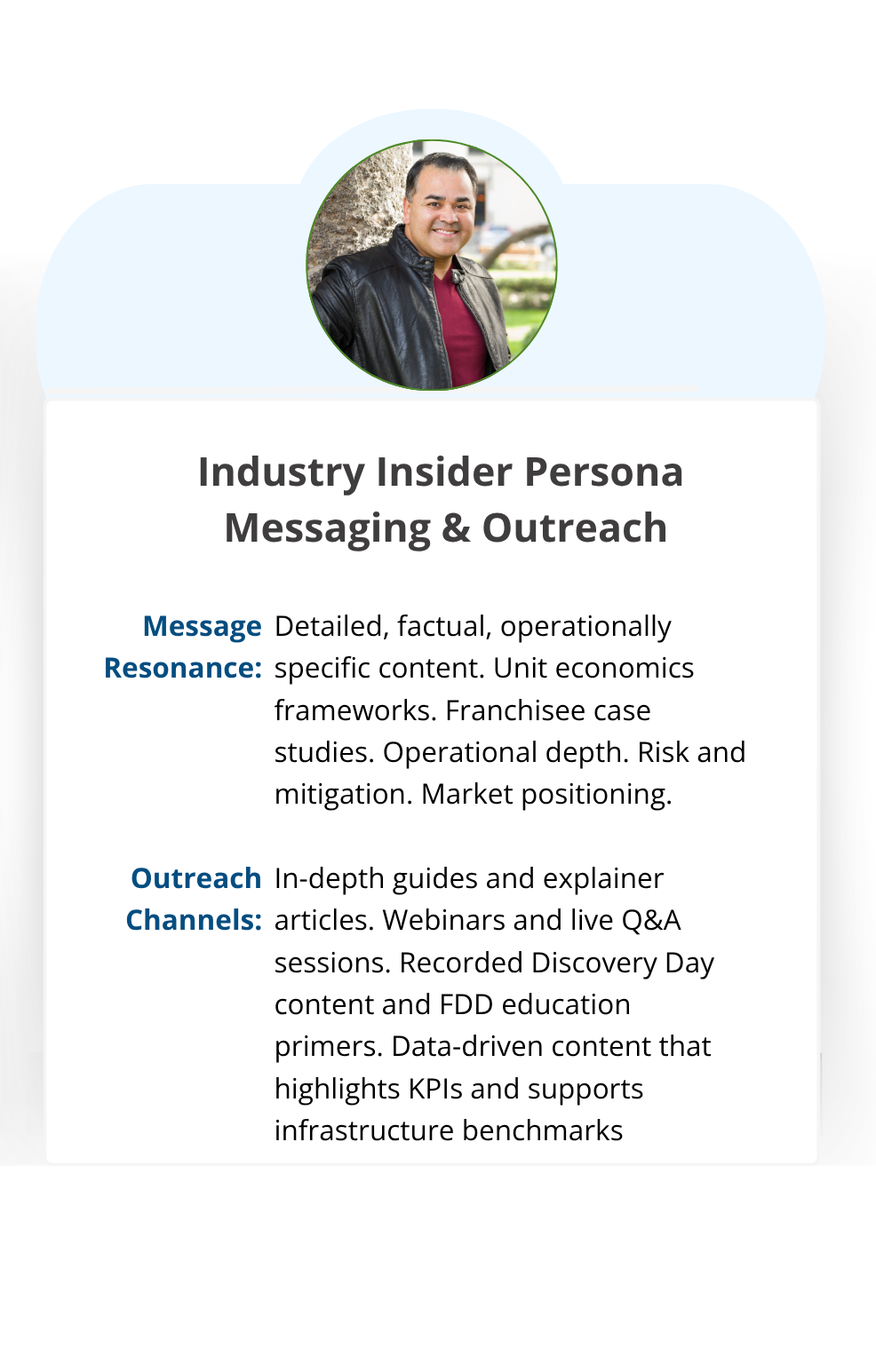
Industry Insiders respond to substance. They will engage with detailed, factual, operationally specific content and disengage quickly from anything that feels promotional, vague, or emotionally driven.
Content themes that resonate include:
Unit economics frameworks: Clear explanations of revenue drivers, cost structure, and margin dynamics, presented educationally without making specific earnings claims outside the FDD
Franchisee case studies: Profiles of owners with similar backgrounds, focusing on ramp timelines, operational challenges, how support was applied, and measurable outcomes
Operational depth: Content that goes inside the system, covering training programs, technology platforms, marketing infrastructure, and field support models
Risk and mitigation: Honest discussion of common failure points, how the system is designed to address them, and what franchisee support looks like when things get hard
Market positioning: How the brand competes and differentiates in its category, including how it defends against local competition and national alternatives
Formats that work well for this persona include:
In-depth guides and explainer articles that reward careful reading
Webinars and live Q&A sessions with operations and development leadership
Recorded Discovery Day content and FDD education primers
Data-driven one-pagers that highlight KPIs and support infrastructure benchmarks
Messaging tone should be:
Professional, concise, and analytical
High in signal and low in promotional noise
Focused on partnership, systems, and performance accountability rather than lifestyle or aspiration
What Outreach and Marketing Strategies Are Most Effective?
Industry Insiders are reachable, but they need to be approached as peers, not as prospects who need to be persuaded that entrepreneurship is a good idea. The positioning, channel, and message must all reflect that they already understand the game.
Effective strategies include:
Targeted LinkedIn campaigns: Advertising and content targeted by job title, industry, seniority, and company type, reaching active operators and managers who match the profile of existing high-performing franchisees
Thought leadership content: Posts and articles about unit economics, multi-unit scaling, exit strategies, and franchise system evaluation that attract this audience organically and establish the brand as a serious operator
Invite-only webinars and roundtables: Events framed around specific professional identities, such as "Franchise Ownership for Operations Leaders" or "From Regional Manager to Multi-Unit Owner," that signal relevance without a generic pitch
Franchise broker and consultant channels: Working with brokers who pre-qualify candidates based on capital availability, background, and investment intent
Nurture sequences with substantive content: Email and content series that deliver FDD education, franchisee validation frameworks, and territory evaluation checklists rather than promotional copy
Sales process considerations for this persona:
Respect their time and match their level of preparation
Lead every conversation with clarity about the process, timeline, and what each stage involves
Provide structured access to performance data and direct contact with franchisees early in the process
What Solutions Help Overcome Their Doubts and Hesitations?
To move an Industry Insider from interest to commitment, the franchise development process must systematically reduce uncertainty and validate the financial and operational story at every stage. Helpful solutions include:
A structured, transparent discovery process: Clear steps, defined timelines, and specific deliverables for each stage of evaluation, with early access to high-level financial frameworks and territory logic
Education-driven content tools: Guides on how to read the FDD, how to build a franchise pro forma, and how to stress-test assumptions against different revenue and expense scenarios
A strong franchisee validation program: Easy access to a cross-section of current franchisees across different tenures, markets, and performance levels, with active encouragement to ask hard questions about ramp time, challenges, and the quality of franchisor support
Direct access to leadership: Meaningful conversations with key leaders in operations, marketing, and development, so the buyer can evaluate the competence and long-term orientation of the people they would be partnering with
Financing support and clarity: Warm introductions to lenders familiar with the franchise model, along with transparent guidance on typical equity requirements, acceptable debt structures, and how similar buyers have funded their investment
Realistic expectations setting: Honest framing of the work involved, likely ramp timelines, and business risk factors, with success positioned as the outcome of partnership and execution rather than brand affiliation alone
Industry Insiders do not need to be sold on franchising as a concept. They need clear, credible, verifiable evidence that your franchise specifically is a strong vehicle for their capital, their expertise, and their long-term financial goals. Brands that can deliver that evidence will earn their serious attention.
What's Up Next?
This installment explored the Industry Insider, a persona defined by operational experience, financial discipline, and a strategic orientation toward franchise ownership. By understanding what this group requires to move from interest to investment, franchisors and marketers can build a development process that earns their confidence and converts their expertise into long-term system growth.
Upcoming articles in this series will continue to explore the full spectrum of franchise buyer personas, offering insights and actionable guidance for franchisors and marketers looking to build stronger, more targeted franchise development strategies.
Check out the other franchise buyer personas in the series:
